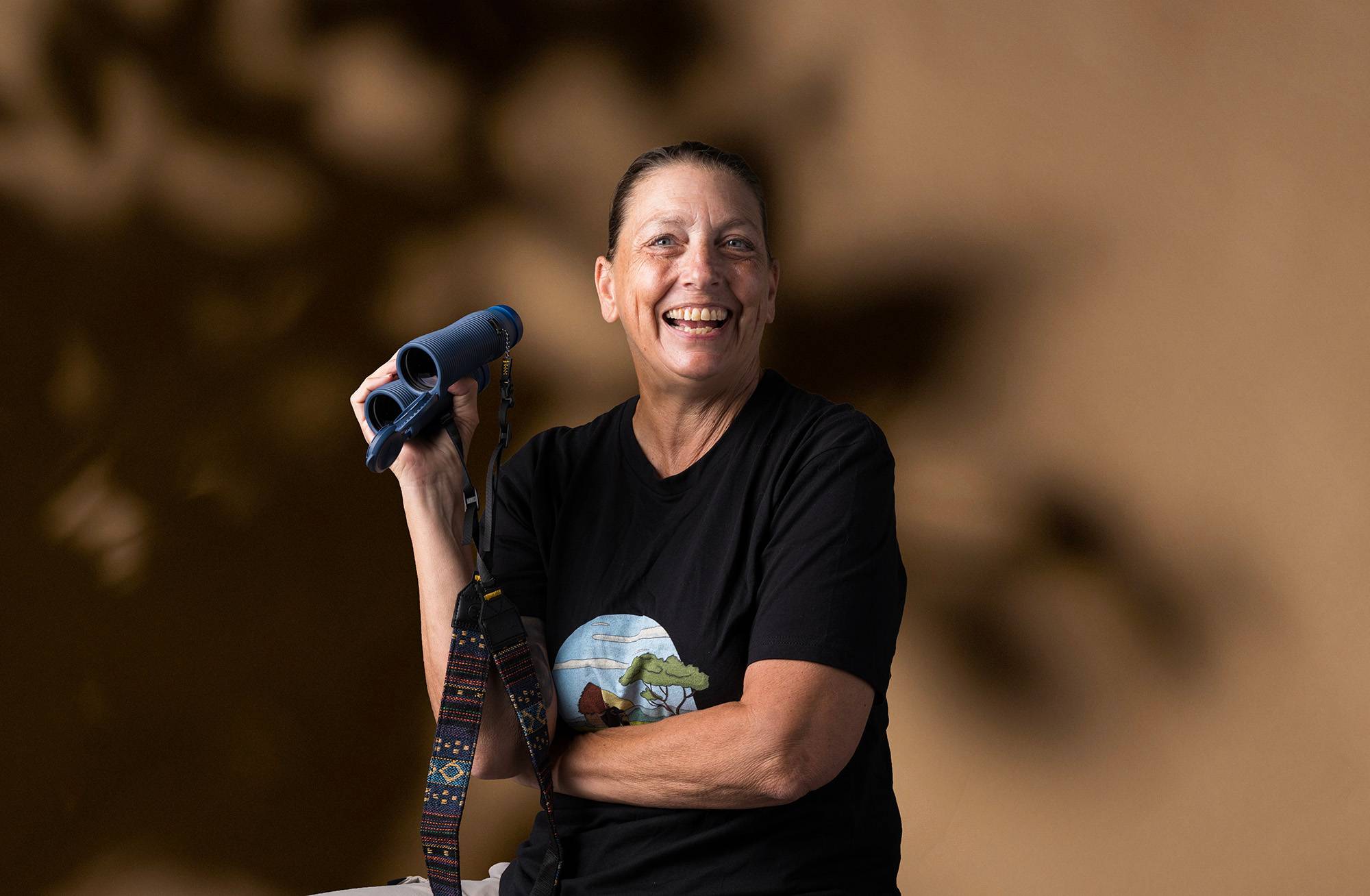
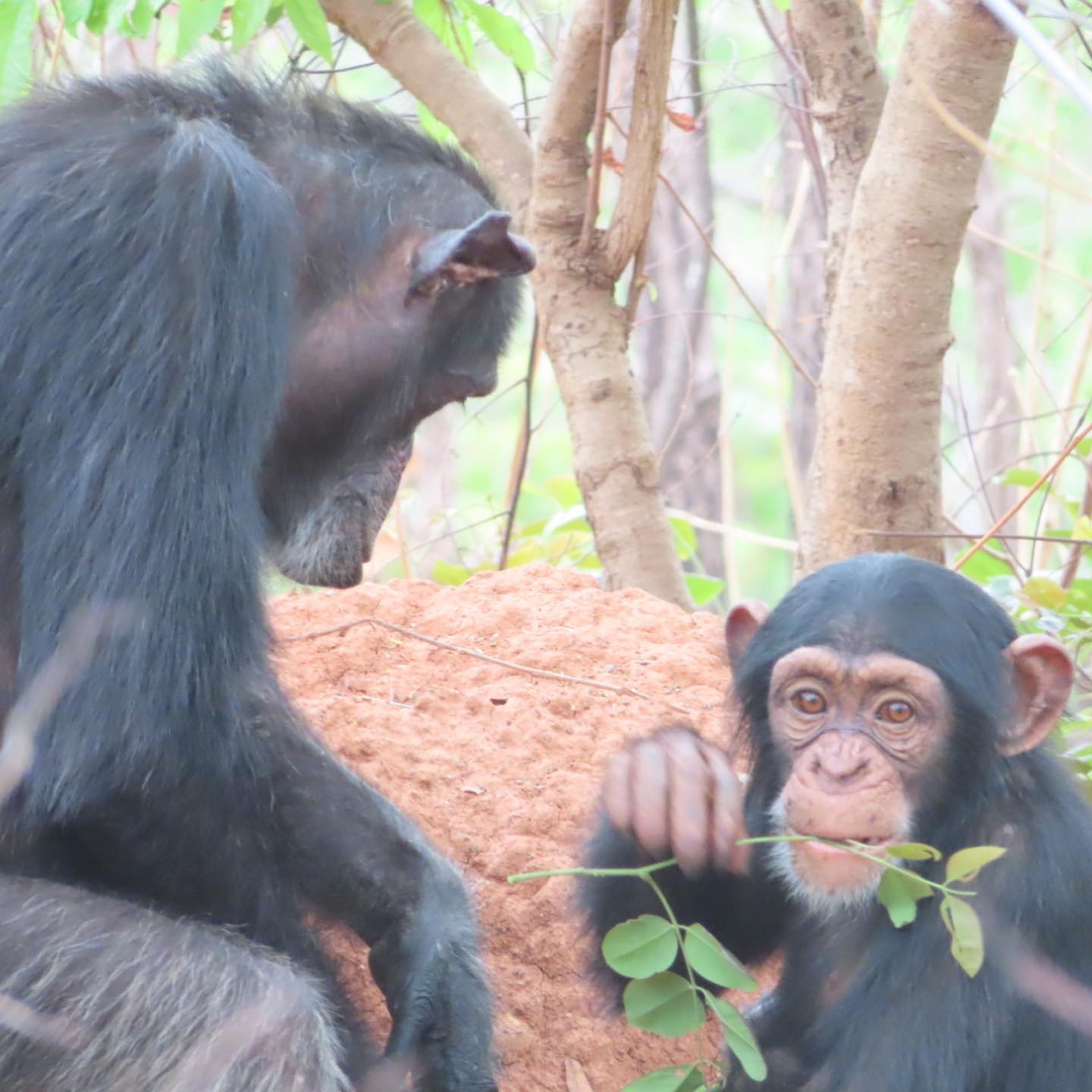
When Dr. Jill Pruetz arrived in western Africa in 2001 as a young anthropologist, many primatologists believed she was trying to do the impossible.
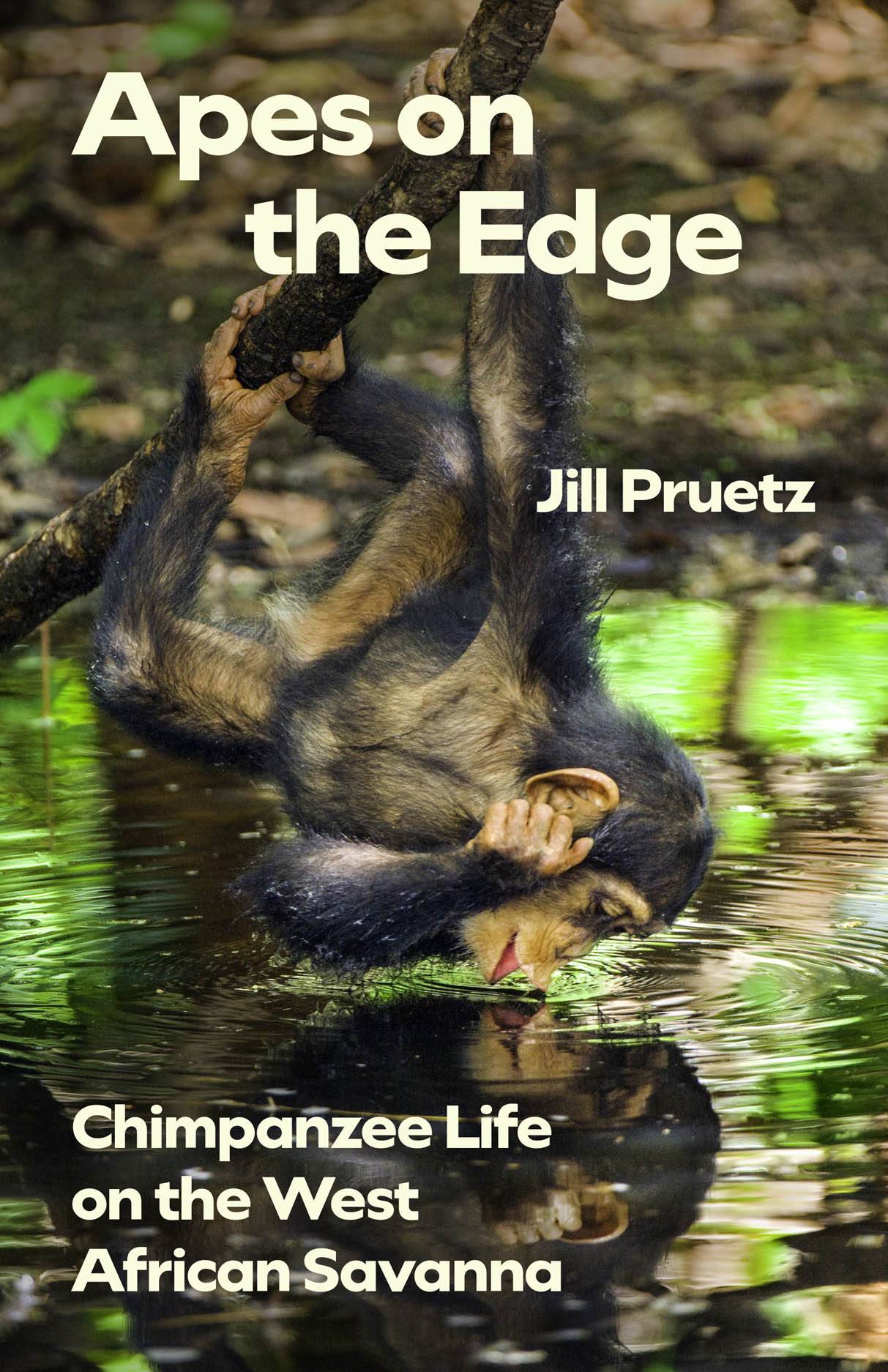
Chimpanzees were already one of the most extensively studied wild animals on the planet, but decades of field research had centered on the lush forests where most chimps live. Pruetz wanted to learn about the smaller populations of chimps that survive on the mosaic of savannas at the hot and semi-arid edge of their native range.
Previous efforts to research savanna chimps had all failed.
“I think I took it as a personal challenge when people told me I couldn’t do it,” says Pruetz, a professor in Texas State University’s Department of Anthropology, the same program she graduated from in 1989.
A quarter century after she established the Fongoli Savanna Chimpanzee Project in southern Senegal, Pruetz’s discoveries have overturned assumptions about chimpanzees and raised new questions about the origins of human behavior. She has also become a leading authority on one of the world’s least understood chimp populations.
A documentary produced by Passion Planet, HumanLike: The Chimps of Fongoli, was also released in the United Kingdom this spring. Tentatively set to premiere in the United States this fall, HumanLike follows Pruetz and Senegalese field researcher Dondo “Johnny” Kante as they study the chimps in the Fongoli Savanna.
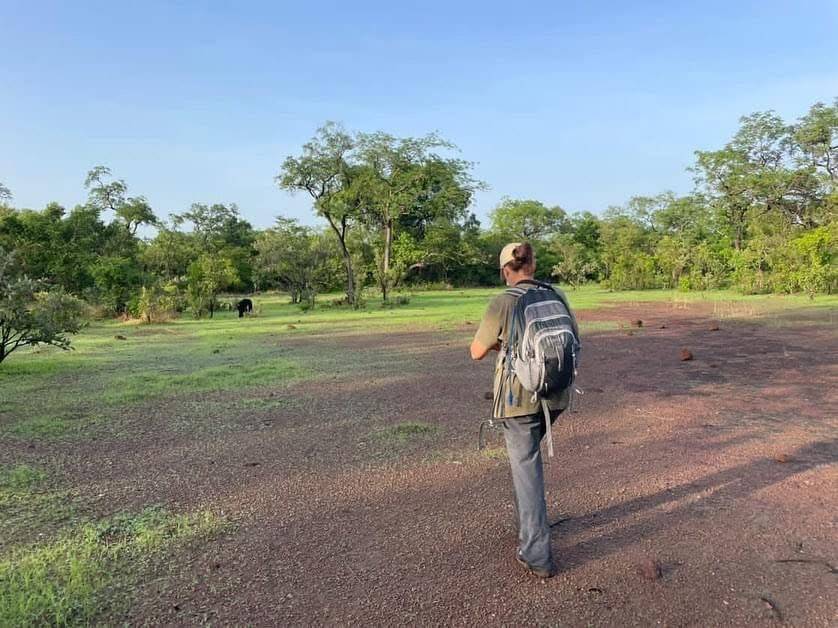
Conditions in Fongoli can be punishing. Temperatures climb past 120 degrees, and water becomes scarce in the dry season. Chimps occupy a home range about 10 times larger than that of chimps in forest communities.
“It’s god-awful,” Pruetz says of the heat. “But the chimps are amazing.”
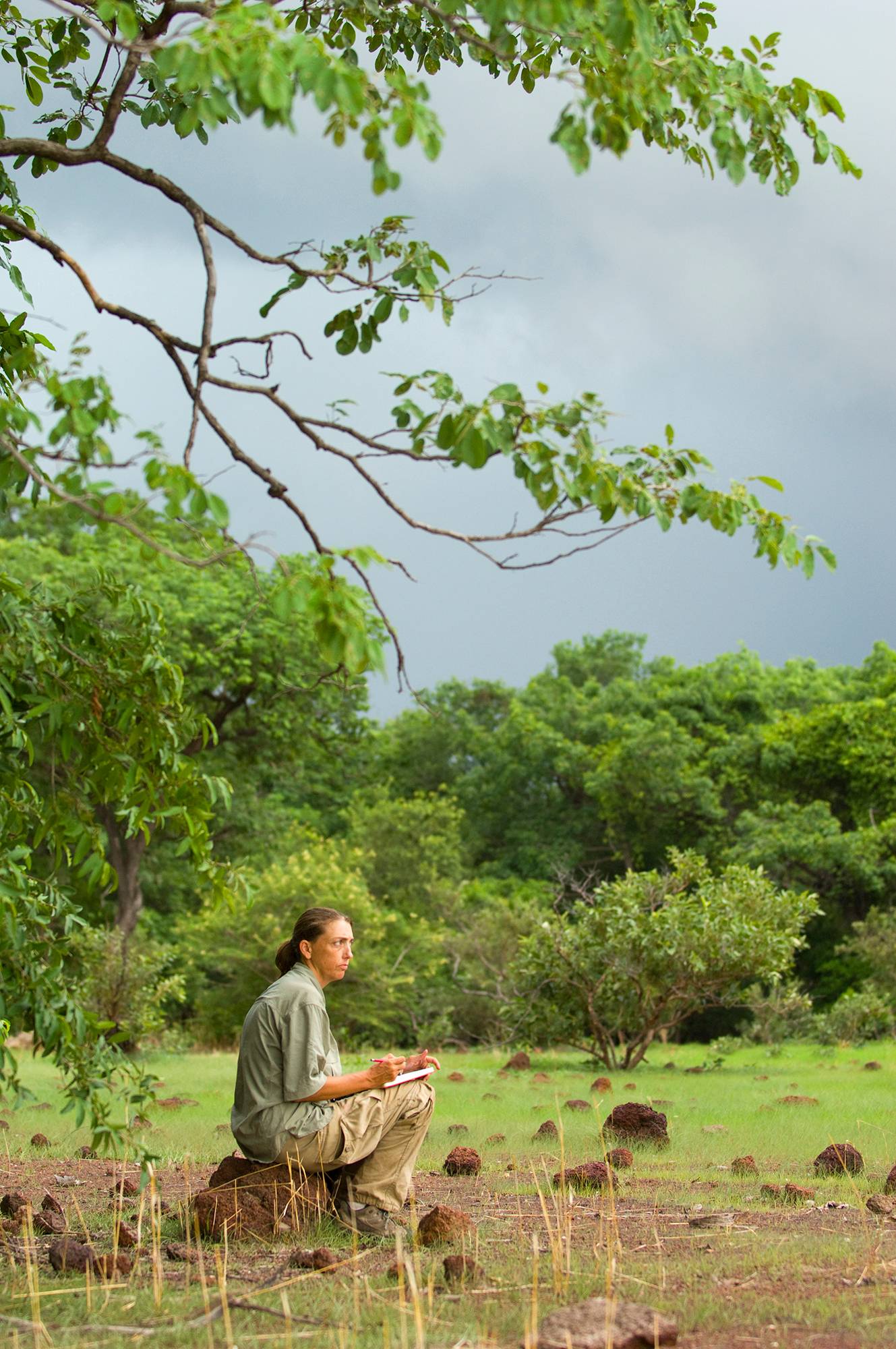
Pruetz visits Fongoli nearly every year, often for weeks to months at a time. When she began her field research, she thought it might take a decade of painstaking effort before savanna chimps would get used to human presence, allowing for close observation.
To habituate the chimps, Pruetz and her team of local researchers waited near one of their primary water sources, keeping visible but far enough away that the chimps could drink without feeling threatened.
“We don’t hide ourselves,” she says. “When the chimps would come, if it looked like they weren’t comfortable, we would move further away.”
Over time, the chimps learned to tolerate their presence and allowed researchers to follow them through the savanna, which is made up of brush, grasslands, and small patches of forest. Pruetz soon confirmed that Fongoli’s harsh environment had shaped these chimps’ behavior in ways that differed significantly from forest chimps.
Savanna chimps, for example, seek refuge from the heat in caves and pools of water. They also seem to predict the intensity and direction of wildfires, calmly moving to safety. They also share their territory with humans.
Then, in 2005, came a discovery that made international news: The chimpanzees at Fongoli hunt other primates with spear-like tools. To make a spear, they break living branches from a particular kind of tree, the Terminalia, then remove the smaller branches.
“They’ll break off the flimsy end,” Pruetz explains, “and then some individuals will trim the tip further with their teeth.”
The chimps hunt by thrusting their spears into the cavities of dead trees, where small nocturnal primates called bush babies shelter during the day.
Until Pruetz’s discovery, the deliberate use of tools to hunt other mammals had been treated as a defining human characteristic.
“Humans hunt with tools. Hunting is important in human evolution. Other animals don’t hunt with tools,” Pruetz says, describing what people had previously believed.
Pruetz also found that females use hunting tools more often than males, upending long-held assumptions about gender roles.
Pruetz encountered significant resistance from some fellow researchers. Critics suggested the chimps were merely playing or that she had misinterpreted what she saw.
“I was surprised at how much skepticism there was,” she says. “I was more surprised by the fact that a lot of people that studied chimps didn’t believe us.”
Pruetz’s first published study documented 22 hunts with tools. The Fongoli project has since recorded nearly 600 cases.
Her findings challenge the “man as hunter” image of early humans. While Pruetz avoids drawing direct parallels between chimps and modern humans, she believes that life in the savanna environment makes chimps act more humanlike.
“To me, that’s really interesting because it has implications for human evolution,” she explains, noting that her research could offer clues about the hominins that lived on the savanna near the time when human and chimp lineages diverged.
Pruetz’s path to anthropology began with an elective at Texas State (then Southwest Texas State University) when she and a friend enrolled in a class called Magic and the Occult. Captivated, she continued to take anthropology classes, eventually completing bachelor’s degrees in anthropology and sociology. After graduation, she volunteered at a federal chimpanzee breeding facility in Bastrop. The chimps’ intelligence and emotional similarity to people fascinated her.
“It’s hard to explain how intelligent they are and how like humans they are unless you have that exchange,” she says. “There’s a lot you can tell about them, just from being human, but there’s so much other complex behavior that you need to study for years and years to understand. I still feel like I’m understanding their behavior.”
Pruetz earned a Ph.D. from the University of Illinois at Urbana-Champaign and taught at Iowa State University from 2001 to 2017, when she joined the faculty at Texas State. Returning to San Marcos, she was reunited with one of her first professors from her undergraduate studies.
“I have known Dr. Pruetz for something like 30 years and watched her develop from a first-rate undergraduate student to an accomplished international scholar,” says Jon McGee, a professor emeritus in the Department of Anthropology.
“In addition to conducting groundbreaking research, she is also helping to train a new generation of primatologists.”
Indeed, Pruetz leads annual, three-week field courses in Costa Rica, where she teaches TXST students how to do hands-on primate work such as conducting censuses, mapping sites, and collecting ecological data in a rainforest that is home to spider monkeys, howling monkeys, and capuchins.
Texas State doctoral candidate Hannah Furchak traces her interest in TXST back to reading about Pruetz’s discovery of chimps hunting with spears. “Wow, that is so cool!” she remembers thinking. “I was like, ‘I want to work with Jill.’”
Pruetz’s energy and intensity are infectious, she says.
“We joke that when she’s in the field, she lives off solar power,” says Furchak, who is now studying how younger chimps learn to use hunting tools from older chimps.
In 2008, Pruetz founded the nonprofit Neighbor Ape to support chimpanzee conservation as well as the welfare of the humans who live alongside them in southern Senegal. For Pruetz, the two goals are inseparable since the people of Fongoli help make the research possible, and their participation is essential to the chimps’ future.
Fongoli’s chimps, thought to number about three dozen, are part of the Western chimpanzee subspecies, which the International Union for Conservation of Nature has classified as critically endangered since 2016. The chimps are on the cusp of losing their habitat to nearby gold mines, tree cutting, and the rapid growth of nearby towns.
There are also honeybees to watch out for. One day at Fongoli, Pruetz was following a male chimpanzee named Bilbo who was about to raid a beehive. Then he stopped short.
“He kept looking at me and looking at me,” Pruetz recalls. It didn’t make any sense. Usually, chimps avoid looking at people. “That’s such weird behavior for him,” she remembers thinking.
Pruetz, who’d been stung as many as 40 times during a previous run-in with bees, got the sense that Bilbo wanted her to move farther away.
“As soon as I moved back, he grabbed the honey and ran,” she says.
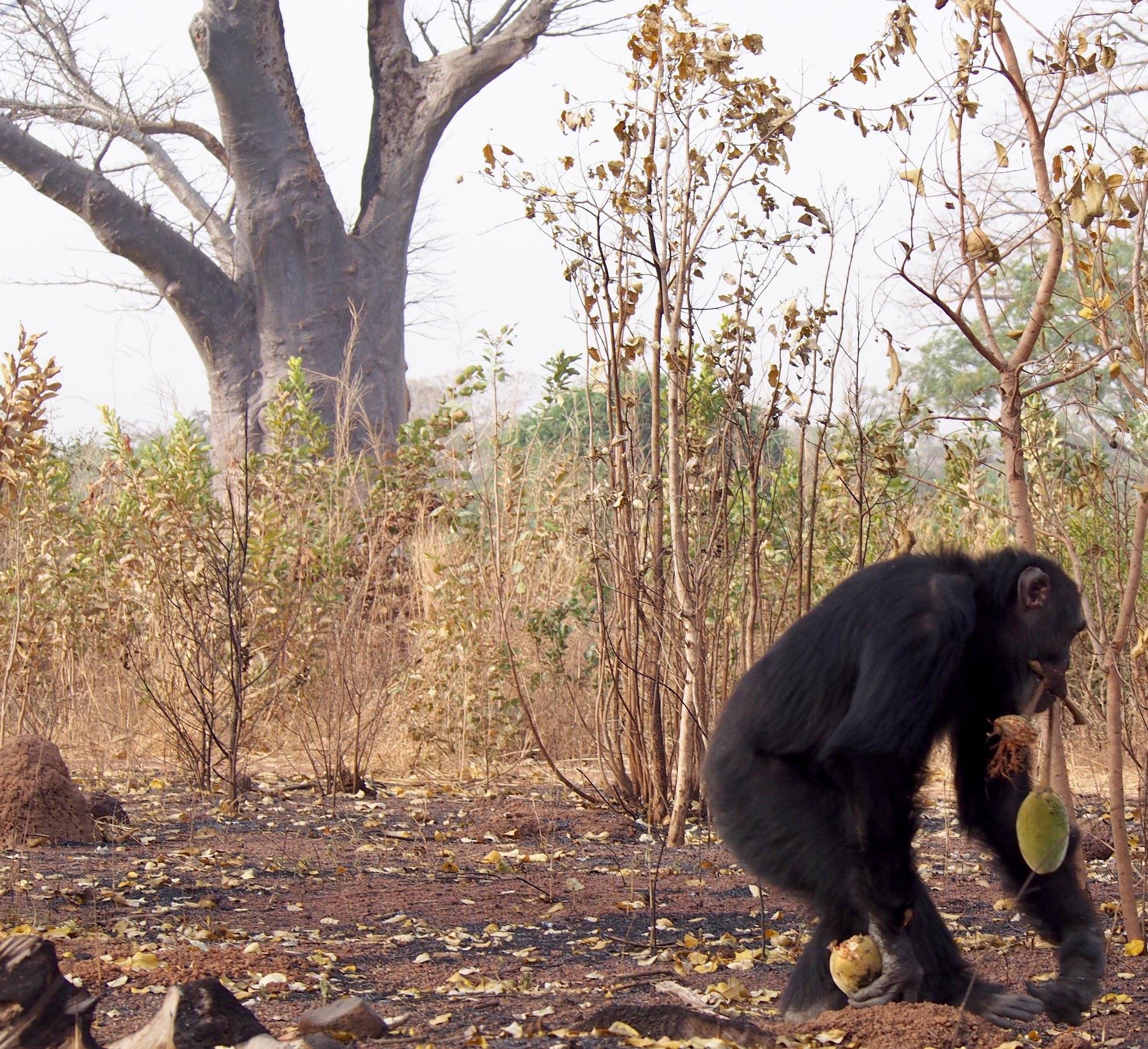
Bilbo carrying baobab fruit
Somehow, Bilbo seemed to understand that Pruetz couldn’t escape the bees as quickly as he could. The swarm followed Bilbo, sparing Pruetz from danger.
“That consideration really endeared me to Bilbo,” she says. “Those types of memories, I think, are the best ones.”
Wes Ferguson
Wes Ferguson is a Central Texas-based freelance writer who authors books and magazine articles. He’s also the founder of Free Range Productions, a studio that makes documentary podcasts.