

Intelligent Agriculture

Tanvir Ahmed builds a data-driven future for cattle care

Tanvir Ahmed came to Texas State with interests in pursuing research on wearable technologies and robotics. As a graduate student in mechanical and manufacturing engineering, Ahmed found opportunities for both, albeit in an unexpected field—cattle ranching. 

Ahmed had not previously considered the agriculture industry, but his arrival coincided with the launch of the AnimalCareBot project. Funded by a four-year, $400,000 grant from the U.S. Department of Agriculture, the project is a collaboration between the Ingram School of Engineering and the Department of Agricultural Sciences. Its missions are to develop a robot to monitor cattle and introduce new students to the agricultural industry.
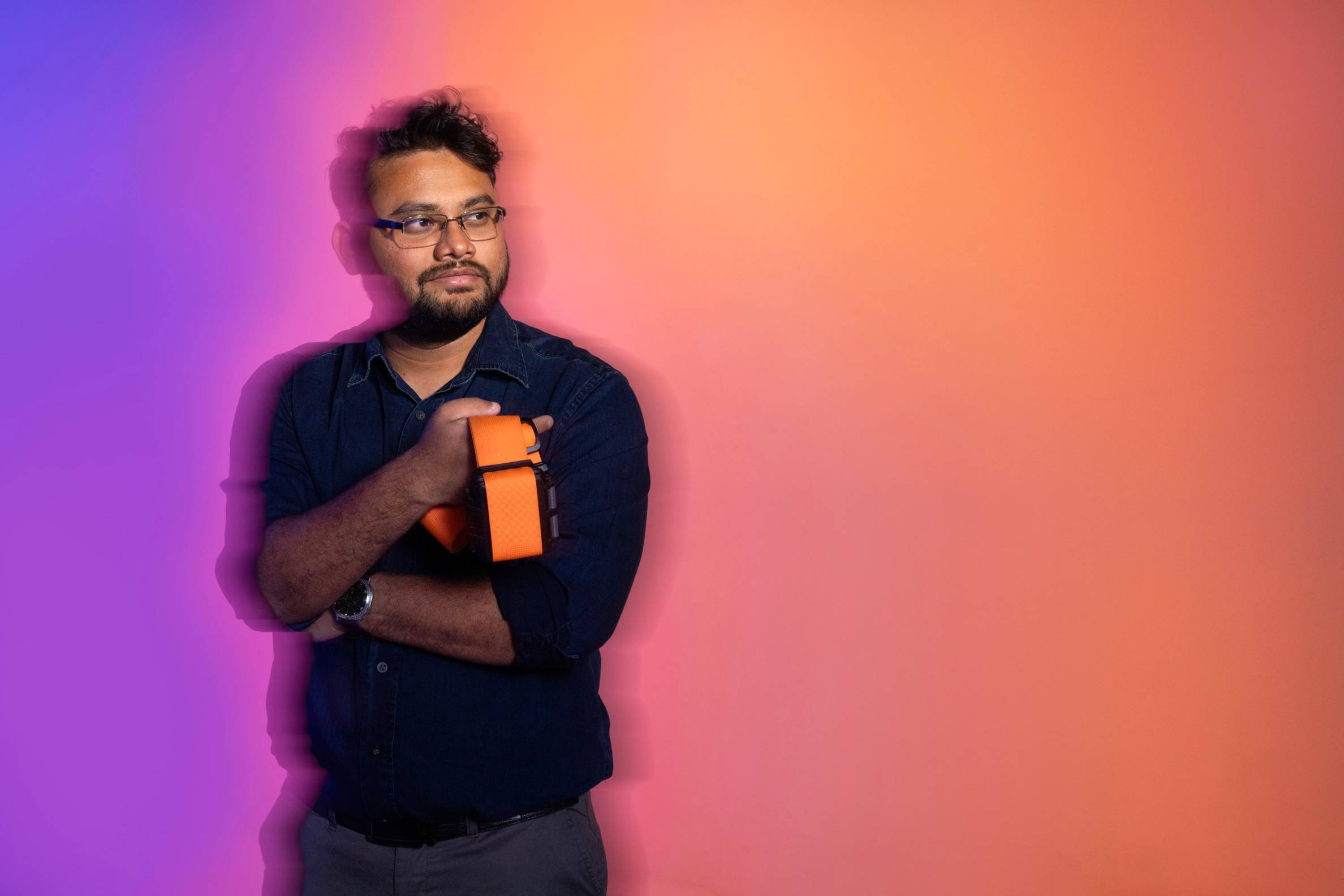
stylized photo of Ahmed Tanvir holding the device he created

“This is robotics, but in agriculture, and currently there is lots of research going on in agriculture, especially in Texas,” Ahmed says. “So, I thought, ‘Why not?’ It’s been very interesting.” 

Ahmed completed his master’s degree in Summer 2025 and is now in the first year of his doctoral studies in engineering. His master’s thesis focused on the development of a smart collar for cattle with sensors that send data to a machine-learning program that interprets cattle behavior.

Ahmed completed his master’s degree in Summer 2025 and is now in the first year of his doctoral studies in engineering. His master’s thesis focused on the development of a smart collar for cattle with sensors that send data to a machine-learning program that interprets cattle behavior.

“With a collar system like this, the farmer can monitor the cattle remotely,” Ahmed says. “Whenever there is an irregularity in behaviors, they can take action. If a cow is idle for a long time, most probably it is sick.” 

For his doctoral studies, Ahmed is working to connect the behavior-detection collar with a cloud-based program that would communicate directly with the AnimalCareBot. He and a team of graduate and undergraduate engineering students are building the robot, which looks like a miniature moon rover, at Ingram Hall Makerspace.

“Tanvir’s skill is not just understanding these elements when implemented but also designing a framework that is highly effective and repeatable,” says Dr. Damian Valles, associate professor of Electrical and Computer Engineering and an AnimalCareBot project director.

“His contribution will help to understand several aspects of electrical and data analysis in animal sciences and understand the limitations of operations. The program will benefit from understanding the limitations of implementing monitoring devices on cattle and the impact the environment can have on them.”

Ultimately, Tanvir says, the goal is for the animal collar to share data with the autonomous robot, which could then locate specific livestock and provide real-time information to ranchers. 

“There are no other systems in the world that have this—the bot and the collar communicating in a loop,” he says.


Matt Joyce

Matt Joyce is the Editorial Manager for TXST's Division of Marketing and Communications.