Protecting Texas for Generations: The Enduring Conservation Legacy of Andrew Sansom

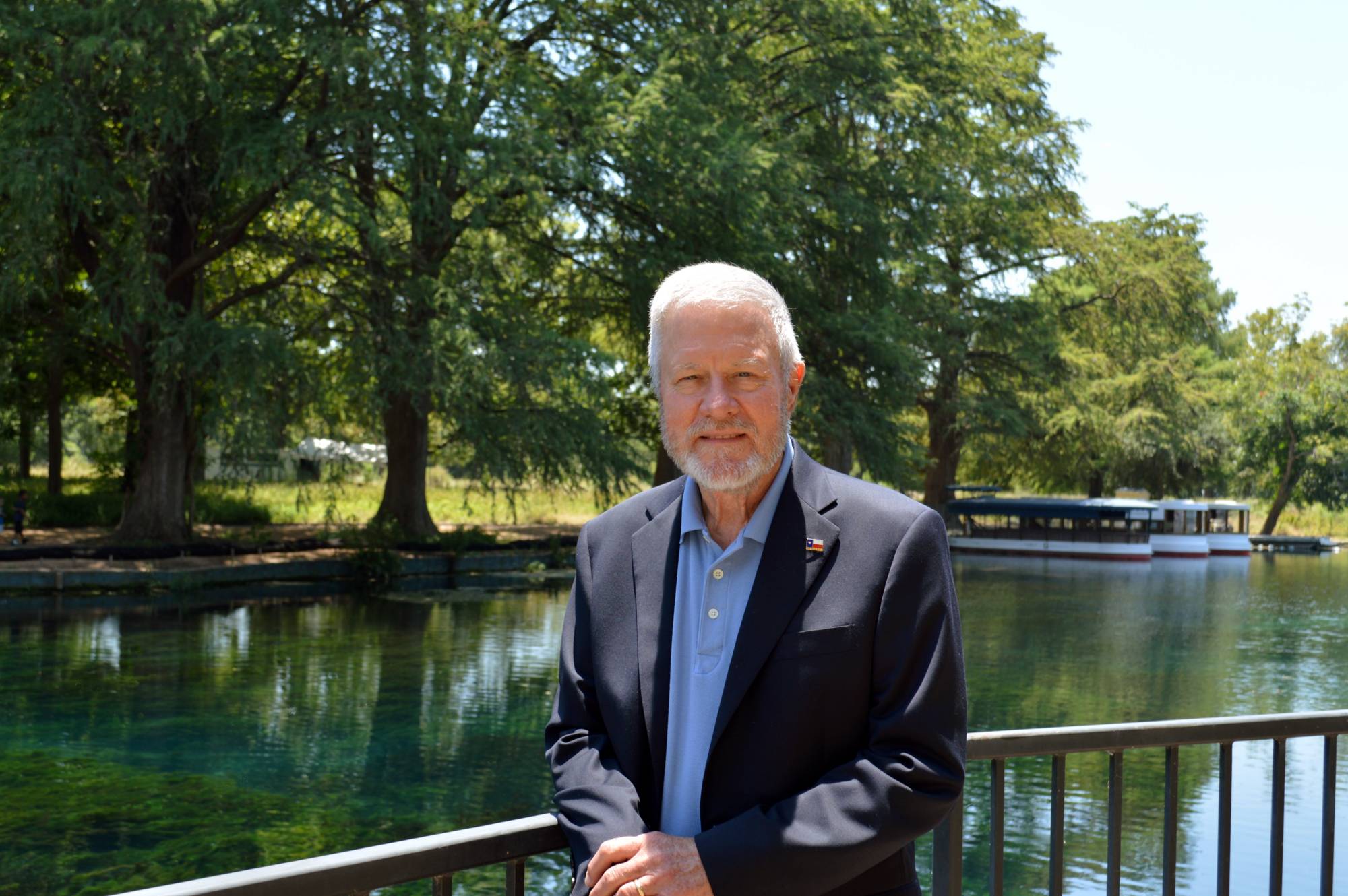
andrew sansom standing outside of meadows center
Sansom was Meadows Center executive director 2002–2020.

A new biography explores how Andrew Sansom, founding director of the Meadows Center, and his decades of leadership transformed land and water conservation across Texas. 

When campers admire the star-filled sky over Big Bend Ranch State Park in West Texas, they are benefiting from the work of Andy Sansom. When paddlers and hikers explore the Big Thicket, north of Beaumont, they are reaping the rewards of his conservation work. And when visitors take a glass-bottom boat tour and learn about water stewardship at Texas State University’s Meadows Center for Water and the Environment, they are enjoying Sansom’s legacy.   

A new biography of Sansom details how the founding director of the Meadows Center protected these natural resources and dozens of others during his environmental conservation career in Texas. Published by Texas A&M University Press, the book is part of the Kathie and Ed Cox Jr. Conservation Leadership series sponsored by the Meadows Center.  

Andrew Sansom: A Life in Conservation details Sansom’s journey from his Lake Jackson childhood to leadership positions in the Texas chapter of The Nature Conservancy, Texas Parks and Wildlife Department, and Meadows Center. Its author is Laura Raun, a former journalist and professional colleague of Sansom’s who conducts public outreach for water projects.

Reflecting on the biography, Sansom said, “I’ve had a real, real fortunate life, but among the most fortunate things in my life is my association with Texas State. It’s hard for me to express the gratitude, the satisfaction, and the excitement of being there for 20 years and seeing it evolve in such a spectacular way. And I’m so proud of it.”

Raun calls Sansom “the Teddy Roosevelt of Texas,” a nod to the early 1900s president who created five national parks and designated more than 230 million acres of land for protection. Sansom himself worked to protect half a million acres of Texas land and helped safeguard the state’s water resources. He also used his legendary people skills to build coalitions during the earliest days of environmental advocacy in the state.  

“He helped solidify those grassroots efforts to make them more organized, more cohesive, higher profile, and better funded, giving them a voice,” Raun said. “He was instrumental in laying the foundations of the modern conservation movement in Texas.”

Sansom grew up visiting state parks with his Boy Scout troop and spending free hours hunting and fishing. While studying parks and recreation management at Texas Tech University, he realized the outdoors needed protection if it was to supply those opportunities for future generations. He spent the early years of his career working for the U.S. Department of the Interior in Washington, D.C., as the environmental movement gained momentum in the 1970s. Alongside elected officials and environmental leaders in Texas, Sansom contributed to the 1974 creation of the Big Thicket National Preserve. He also was instrumental in initiating the transformation of Matagorda Island, home to endangered whooping cranes, from a military training ground to a wildlife refuge. 

Courtesy of Laura Raun

Sansom (right) with Texas Governor Ann Richards on a Rio Grande rafting trip in Big Bend in the 1990s.

In 1982 Sansom became the executive director of the Texas chapter of The Nature Conservancy, which preserves sensitive environmental lands through conservation easements or outright purchase. At The Nature Conservancy, Sansom discovered what Raun calls “the thrill of the ‘creative transaction’ —bringing together buyers and sellers in any way necessary to protect the environment for future generations.” He helped protect Honey Creek State Natural Area in the Hill Country, threatened coastal wetlands, and segments of Blackland Prairie. One of his signature achievements was facilitating the incorporation of 57,000 acres of West Texas land donated to The Nature Conservancy into Big Bend National Park. 

“He was instrumental in laying the foundations of the modern conservation movement in Texas.”

After five years at The Nature Conservancy, Sansom brought his land acquisition and deal-making expertise to the Texas Parks and Wildlife Department. He soon brokered the purchase of Big Bend Ranch State Park, an acquisition that nearly doubled the acreage of parkland owned by the state. Other significant buys included land that became the Devils River State Natural Area, Old Tunnel State Park outside Fredericksburg, and several wildlife management areas along the coast.

In 1990, Sansom was named executive director of the Texas Parks and Wildlife Department. During his 11 years in leadership, he expanded the agency’s focus beyond hunting and fishing and encouraged more park use by children and families. To augment the agency’s state funding, he formed the nonprofit Texas Parks and Wildlife Foundation, which has raised more than $200 million for conservation in Texas, and successfully advocated for the issuance of bonds for deferred park maintenance.

Courtesy of Laura Raun

Sansom (right) with Texas Lt. Gov. Bob Bullock at the rededication of the Texas State Cemetery in 1997.

When TXST bought Spring Lake in 1994—under the leadership of the late Jerry Supple, former university president—Sansom arranged for Parks and Wildlife to partner with the university to convert the old Aquarena Springs amusement park into an education center for the public. 

The connection to TXST remained strong, and in 2002, Sansom accepted Supple’s invitation to direct the institute that today is called The Meadows Center for Water and the Environment.  

Sansom established a strong research program into environmental flows, the water that passes through rivers and streams to bays and estuaries and is a critical part of the ecosystem. An advocate for environmental education, he launched programs for students and expanded a community science initiative called the Texas Stream Team, which trains volunteers to collect water quality samples.  

Sansom also earned his doctorate in Geographic Education from TXST under the tutelage of Richard Boehm, professor emeritus of Geography and Environmental Studies. His dissertation examined the impact of the Meadows Center’s environmental education programs on students and teachers and revealed that up to a quarter of entering freshmen at TXST cite the river and springs as influences in their decision to enroll.   

Courtesy of Laura Raun

Sansom and Richard Boehm, professor emeritus of Geography and Environmental Studies.

In 2020, Sansom passed the directorship of the Meadows Center to Robert Mace, a hydrologist who had worked on water resources and conservation for 18 years at the Texas Water Development Board. Sansom’s shoes were tough to fill, Mace said, calling his predecessor “legendary in Texas” for his conservation work. “I interacted with him in my state career and always held—and continue to hold—an immense amount of respect for him,” Mace said. 

Under Mace’s leadership, the Meadows Center has continued to produce water-related research to inform policy at the state and local level. Its reports are written to be accessible for legislators and the general public; more technical versions are published in academic journals, bringing TXST’s work to a worldwide audience 

“The story of Texas is the story of the United States and the story of the world, with respect to water and the environment,” Mace said. “If we’re able to publish in journals, we then carry our impact and what we learned onto the global stage.”

Sansom, mostly retired, still teaches a Conservation Leadership class at TXST. The curriculum is a mix of his “war stories” from the field and talks by contemporary leaders in conservation.  

In November, when he learned the university had purchased Sink Spring and Sink Creek, which feed Spring Lake, he credited President Kelly Damphousse and university leaders for investing in a property that, because of its environmental sensitivity, will add to the preservation of the springs. “That is the most incredible thing for the university to do,” Sansom said. “It’s a conservation victory, and I could not be prouder of the university for doing it.” 


Robyn Ross

Austin-based independent journalist Robyn Ross has written for many university magazines as well as Texas Monthly and The New York Times.